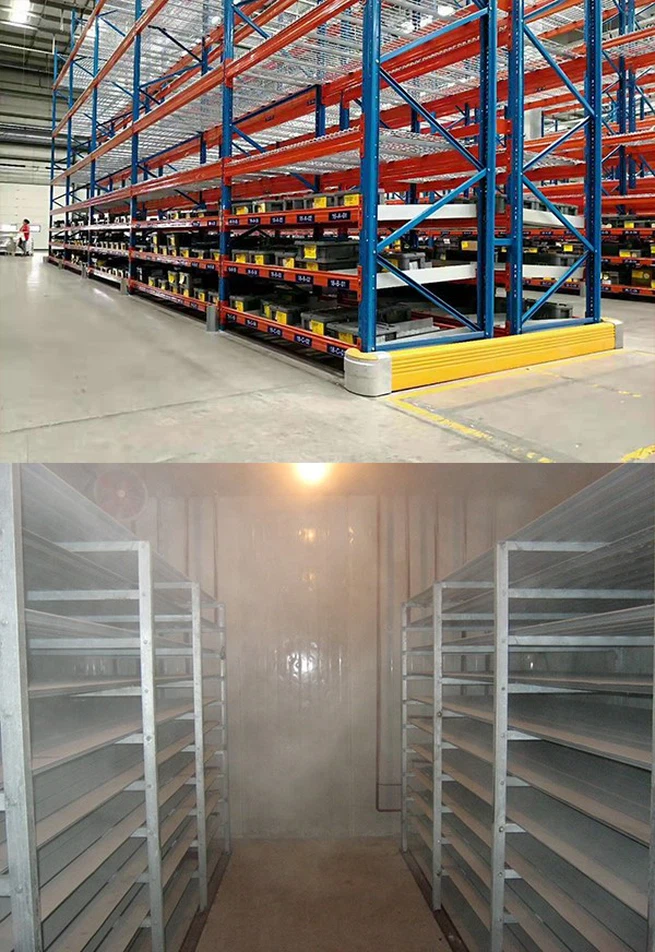
There are significant differences between smart cold storage shelves and ordinary warehouse shelves in terms of materials, efficiency, technical requirements, design requirements and operation. Below is a detailed explanation of these differences.
1. Material
The temperature in the cold storage is very low, so the cold storage shelves need to be made of materials with good toughness and strong corrosion resistance, and they need double-layer protection of anti-rust and anti-freeze layers to prevent rust. Ordinary shelves are made of relatively ordinary materials and do not have too many requirements. They will become fragile and unable to store goods in cold storage for a long time.
It is very important to choose shelves with high corrosion resistance. For example, JUSTBEST shelves use special steel with alloys such as Al, Mg, Ni, Cr, etc., whose corrosion resistance is significantly higher than ordinary steel. At the same time, the surface treatment of JUSTBEST anti-corrosion shelves has been strictly controlled, and the secondary coating process of highly corrosion-resistant paint is used to improve the sealing performance of the coating. JUSTBEST provides various types of anti-corrosion shelves, such as beam shelves, shuttle shelves, corbel-type shelves and through-type shelves. These shelves also play an important role in the hazardous waste treatment industry, reducing the investment cost of fixed assets and Reduces the management and time costs of replacing shelves.
2. Efficiency
Cold storage rooms usually use smart cold storage shuttle racks, which are semi-automated racks. The forklift puts the goods on the shuttle, and then the shuttle transports the goods to the corresponding cargo space, realizing a semi-automatic access method with high access efficiency. Ordinary shelves rely on manual labor or forklifts for access, which is less efficient.
3. Technical requirements
Intelligent cold storage shelves have high technical requirements. Not all storage shelf manufacturers can manufacture them. Professional manufacturers need to strictly control the manufacturing to complete them. Ordinary warehouse shelves do not have high technical requirements, and most shelf customization manufacturers can produce them.
4. Design requirements
The design of cold storage shelves is similar to that of ordinary warehouse shelves, but cold storage shelves have special requirements for materials and anti-rust coatings. Cold storage shelves require double protection (anti-rust layer and freezing layer). Due to different temperatures, different materials are used. Ordinary warehouse shelves do not have these special requirements when designing and producing them.
5. Run
Cold storage shelves are not disturbed and affected by low temperatures and can be used and operated normally in the cold storage room without moving in a short period of time. However, ordinary warehouse shelves are not suitable for cold storage rooms due to temperature and material limitations, and cannot operate stably.
In the manufacturing of storage shelves, the commonly used carbon structure type is Q235, and the specific models are Q235A, Q235B, Q235C, Q235D, and Q235E. Different grades require different temperatures. For example, Q235C is suitable for zero degrees and above, Q235D is suitable for minus 20 degrees and above, and Q235E is suitable for minus 30~40 degrees. Therefore, when customizing cold storage shelves, you need to understand the temperature conditions of the cold storage and do a good job in scientific design.
Since cold storage shelves have high resource utilization and high maintenance costs, it is very important to choose storage shelves with high space utilization. Drive-in racks and shuttle racks meet the high standards of cold storage, and beam racks, push-in racks, and narrow aisle racks can also be put into use.
Choosing a suitable shelf system can significantly improve warehousing efficiency and reduce operating costs, and is an important part of warehousing management.